
insight 2026-07-09
Gas Turbine Localization: Beyond Component Self-Reliance to the Heart of the Materials Industry
For decades, localizing gas turbines has been a national task in the domestic power generation industry. As the beating heart of national energy infrastructure, these turbines dictate both power efficiency and the stability of the grid. Yet, daunting technological barriers have historically forced a complete reliance on foreign technology and core materials.
The true challenge lies in the operating conditions: gas turbines must perform flawlessly in extreme, high-pressure environments where temperatures soar beyond 1,600 degrees Celsius. Surviving this inferno demands more than just precision engineering. It requires advanced, high-performance metal material technologies, including special stainless steels (STS) and superalloys. Ultimately, the drive to localize gas turbines transcends merely assembling the equipment on domestic soil. It represents a groundbreaking leap toward technological sovereignty, dismantling the long-standing monopoly held by global giants over core material technologies.
Understanding Gas Turbine Principles and Structure
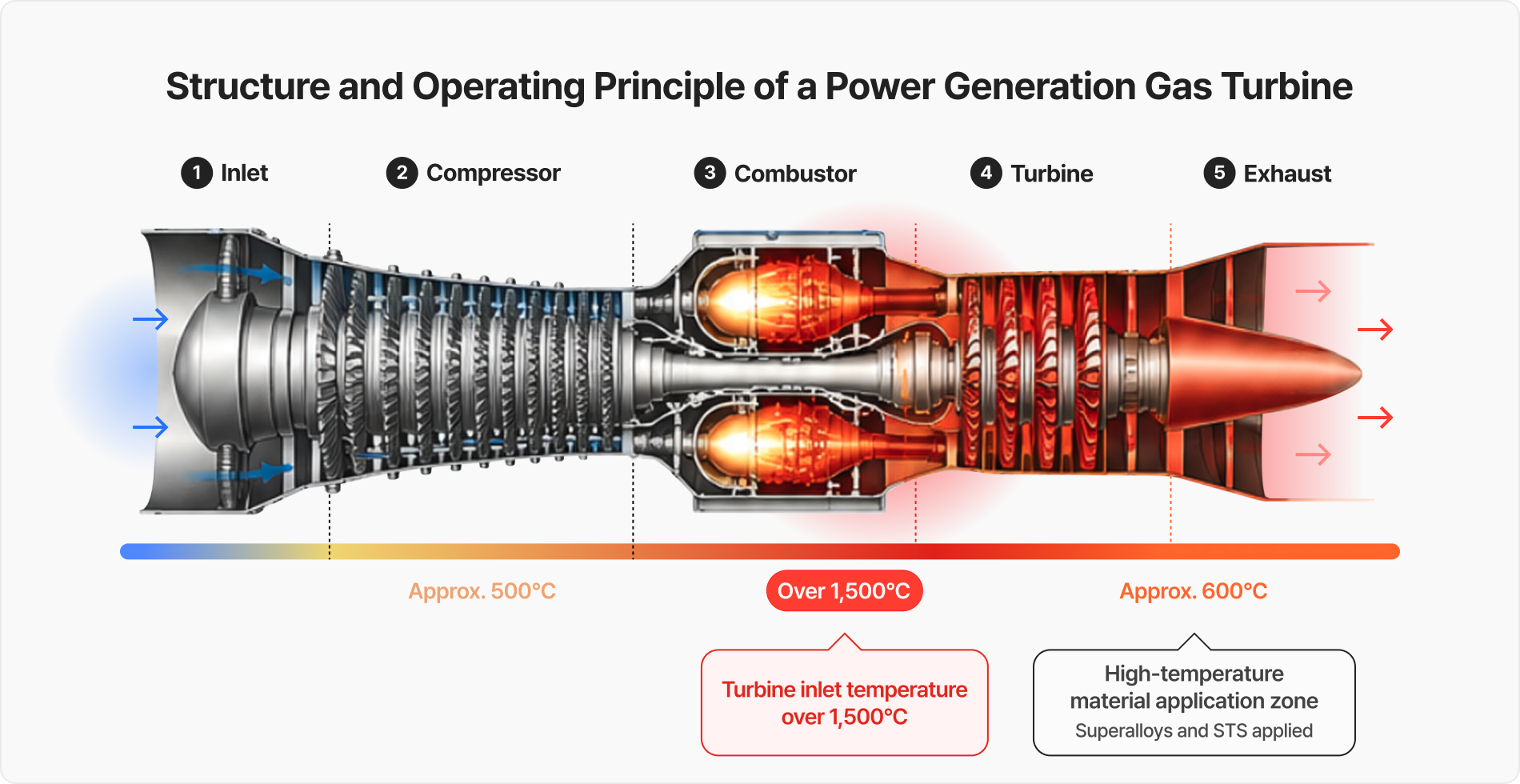
Generating Electricity Through Compression, Combustion, and Expansion
A gas turbine is a power generation system that produces energy by drawing in and compressing air, igniting it with fuel, and using the resulting high-temperature, high-pressure combustion gas to drive a turbine. Its fundamental architecture consists of three core modules: the compressor, the combustor, and the turbine. As the compressed air ignites with the fuel, it unleashes explosive energy that strikes the turbine blades, generating immense rotational force.
In power plants, this rotational force is transmitted to a generator to produce the electricity we use daily. In aviation, however, the exact same mechanical principle is harnessed within aircraft engines to create the massive thrust required for flight.
Why Internal Temperature Defines Technological Competitiveness
The absolute defining metric of a gas turbine's performance and efficiency is the temperature of its combustion gas. Simply put, the ability to safely control and harness hotter gases dramatically minimizes energy loss and maximizes power output.
However, pushing these thermal limits transforms the turbine's interior into an incredibly hostile environment. Standard metals exposed to such extreme heat are highly susceptible to melting and structural deformation. Consequently, the engineering prowess required to guarantee flawless operation and reliability under blistering temperatures has become the benchmark for evaluating a gas turbine manufacturer's global competitiveness.
Why Power Plants and Aircraft Engines Choose Gas Turbines
The greatest assets of gas turbines are their immense power density and exceptionally rapid startup capabilities. Compared to traditional coal-fired plants, they offer drastically shorter ignition times and highly responsive output control. This agility makes them an invaluable, flexible resource capable of offsetting the inherent volatility of renewable energy, which fluctuates with changing weather conditions. Furthermore, their superior power-to-weight ratio allows for a much smaller and lighter physical footprint without sacrificing output. Thanks to these strengths, gas turbines are widely utilized not only to stabilize power grids but also as the critical driving force behind state-of-the-art aircraft engines.
The Rising Prominence of Gas Turbine Power Generation
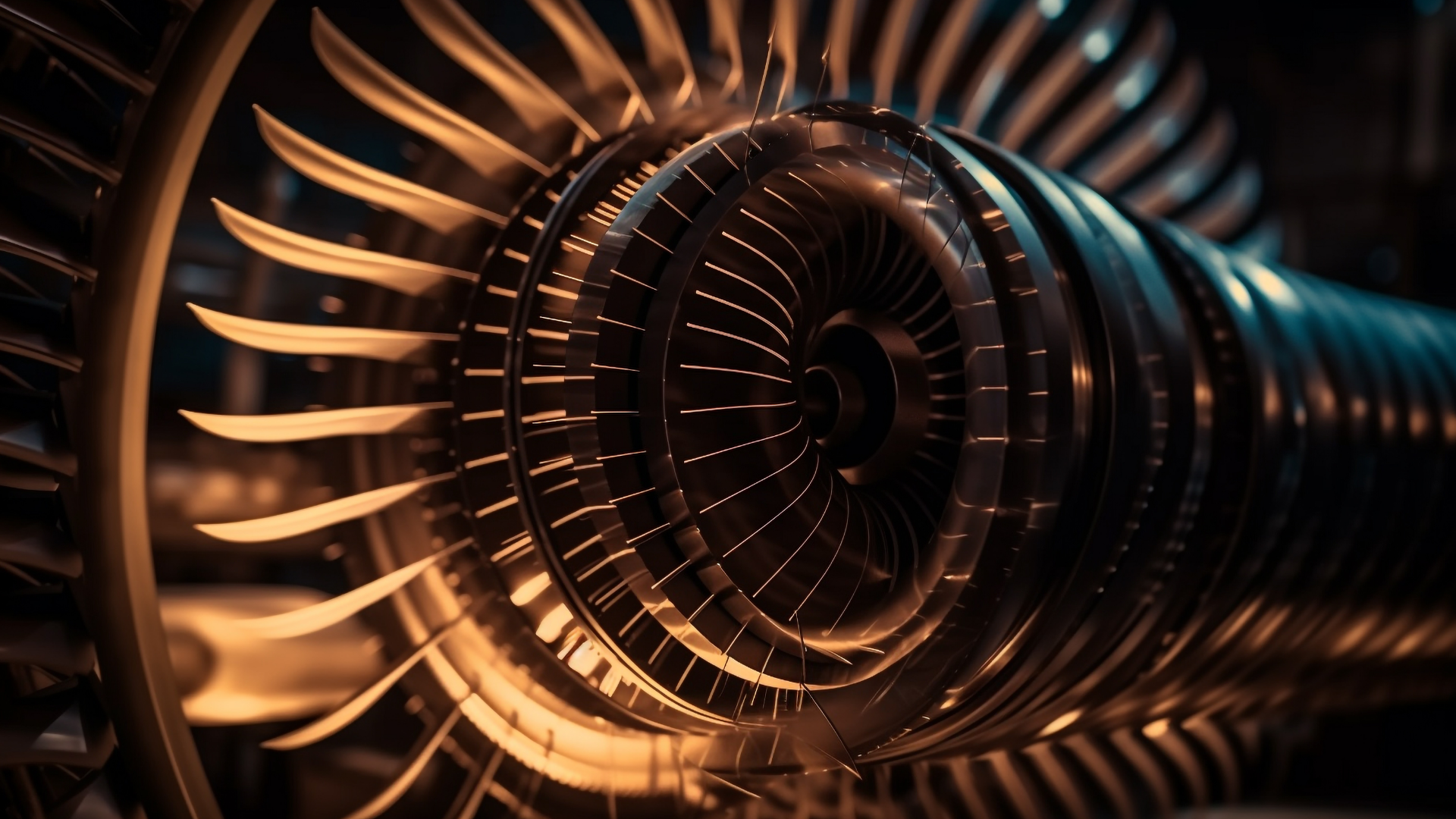
Gas turbines are cementing their status as the backbone of the modern power generation industry, driven by their superior efficiency and rapid output control. As the global push for renewable energy injects greater volatility into power grids, the demand for highly flexible gas turbines has never been more critical. Concurrently, the fierce race to maximize power generation efficiency has cast a spotlight on the advanced metal and high-temperature material technologies that dictate gas turbine performance.
Turbine Inlet Temperature Directly Linked to Power Generation Efficiency
Turbine inlet temperature (TIT) indicates the temperature of the combustion gas at the exact point it flows into the turbine. Fundamentally, a higher TIT allows fuel energy to be utilized more effectively, triggering a dramatic surge in power generation efficiency.
Driven by this reality, global gas turbine manufacturers are engaged in intense technological competition to push turbine inlet temperatures to new extremes. As a result, the latest large-scale gas turbines for power generation are evolving to realize a TIT of 1,600 degrees Celsius or higher.
Expansion of Combined Cycle Power Generation and the Changing Role of Gas Turbines
In recent years, the energy industry has aggressively adopted combined cycle power generation to minimize carbon emissions while maximizing efficiency. This highly efficient system operates in two stages: it first powers a gas turbine, then captures the high-temperature exhaust heat—rather than venting it—to drive a secondary steam turbine.
In these sustainable systems, the gas turbine transcends its traditional role as a mere power generator. It functions as the plant's control tower, dictating the operational success of the entire facility. The higher the gas turbine's output and exhaust thermal energy, the more power the subsequent steam turbine can extract, dramatically boosting overall generation efficiency.
As the deployment of combined cycle plants accelerates, the performance and reliability of the gas turbine are becoming increasingly critical, serving as the core factors that define both the operational efficiency and the economic viability of modern power facilities.
Metal Deformation in Extreme Environments
Amid fierce competition to elevate power generation efficiency, gas turbines are evolving to operate at increasingly higher temperatures. Consequently, this thermal escalation imposes a severe burden on internal metals, elevating the technology required to sustain performance in extreme conditions to a critical industry challenge.
Specifically, prolonged exposure to heat reaching 1,650 degrees Celsius exponentially increases the structural strain on materials. Core components like turbine blades and discs face the constant threat of critical metal deformation, encompassing several severe degradation phenomena.
For instance, creep involves the slow, microscopic elongation of metals subjected to prolonged stress at elevated temperatures. Oxidation occurs when ultra-high-temperature gases react with oxygen, corroding the surface and creating scale that compromises material integrity. Additionally, thermal fatigue induces internal cracking due to the rapid heating and cooling cycles associated with frequent plant startups and shutdowns.
Left unchecked, these degradation phenomena shorten component lifespans and can trigger major operational accidents. Therefore, securing a robust domestic supply chain of STS and high-value alloys capable of flawlessly withstanding these extremes remains the ultimate objective of gas turbine localization.
Impact of Gas Turbine Localization on Korea's Energy Security
Gas turbines are core facilities that dictate power generation efficiency and national power supply stability. However, due to high technological barriers and complex supply chain structures, core components and materials have been supplied primarily by a few global companies. In this environment, as the importance of supply chain stability and energy security has grown, the need to secure a domestic technological foundation and production capabilities has also begun to draw attention.
The Reality of Global Monopoly and High Dependence on Overseas Imports
The gas turbine stands as the crown jewel of mechanical engineering—a premier, high-value sector where design, manufacturing, and advanced metallurgy converge. Historically, however, the Korean power generation market has depended entirely on equipment supplied by a select few global corporations. As the procurement of core components and special steel materials was tied exclusively to overseas supply chains, domestic power plants faced significant structural limitations. This reliance left them highly susceptible to critical supply chain disruptions and stripped them of the leverage needed to proactively address steep maintenance, repair, and operations (MRO) expenses.
Japan's 2019 Export Restrictions: A Wake-Up Call for Material Independence
The vulnerabilities of this supply chain were starkly exposed during Japan's unexpected export restrictions in 2019. The ensuing disruption, which began with semiconductor and display materials, shook the advanced materials supply chain across all industrial sectors.
This dependence was particularly concerning in the gas turbine sector. Because the special steels, high-strength STS, and superalloys required for turbines were strictly monopolized by a select few technologically advanced nations, the crisis highlighted a severe strategic risk: a highly concentrated supply chain could effectively hold the nation's power infrastructure hostage.
Serving as a critical turning point, this event galvanized the push to localize and secure independent supply chains for strategic metal materials. Today, this strategic imperative extends across the entire future energy industry, encompassing vital components for gas turbines, permanent magnets, and nuclear fusion technologies.
The Value of Gas Turbine Localization for Energy Security and Tech Independence
Ultimately, localizing gas turbines not only transcends the assembly of domestic parts but also represents the realization of true energy security and technological sovereignty. By securing control over the core engines of the power grid, the nation can forge a resilient energy supply chain that remains unshaken by shifting global geopolitics.
Furthermore, this breakthrough serves as a powerful catalyst, elevating the high-value capabilities of the entire industrial ecosystem. It triggers a profound ripple effect, driving advancements across domestic special steel processing, precision casting, superalloy development, and advanced machining. In the end, securing this technological bedrock does more than just fortify energy security; it cements the nation's broader industrial competitiveness and ensures lasting independence.
Core Metal Materials Overcoming the Limits of Gas Turbines
The Role of STS in Defending Against High-Temperature, High-Pressure Corrosive Environments
The periphery of a gas turbine's combustion chamber, piping systems, heat exchangers, and outer casings are constantly exposed to thousands of degrees of high-pressure gases and harshly corrosive exhaust gases. The core material that serves as the skeleton and pathway of the facility in this area, ensuring long-term stability, is STS.
The components surrounding a gas turbine's combustion chamber, including its piping systems, heat exchangers, and outer casings, are relentlessly exposed to blistering, high-pressure heat and highly corrosive exhaust gases. In these extreme zones, STS serves as the critical core material, acting as both the structural backbone and vital conduits to guarantee long-term operational stability.
Unlike standard steel, STS retains exceptional corrosion resistance and mechanical strength even under immense thermal stress. It serves as the ultimate line of defense, fundamentally preventing catastrophic failures such as thermal expansion, structural corrosion, and hazardous gas leaks.
Superalloy Components Withstanding 1,650 Degrees Celsius
The core rotating components that bear the brunt of the gas turbine's hottest flames—namely the turbine blades, vanes, and discs—require advanced materials that transcend the limits of standard stainless steel. These critical parts must simultaneously withstand temperatures exceeding 1,600 degrees Celsius and the immense centrifugal forces generated by ultra-high-speed rotation.
To survive these punishing conditions, the industry turns to superalloys. Formulated primarily from nickel and cobalt, these special alloys are engineered to maintain exceptional structural strength, oxidation resistance, and creep resistance under extreme thermal stress. They are the vital enablers that guarantee the performance and longevity of core components in the most unforgiving operating environments.
SeAH CSS' Technological Prowess in Localizing Gas Turbine Materials

With turbine inlet temperatures continuously rising to maximize power generation efficiency, the strategic importance of high-performance metals such as STS and superalloys has never been greater. In response to this industry imperative, SeAH CSS is pioneering the localization of gas turbine materials, anchored by its globally competitive special steel production infrastructure.
Unrivaled Integrated Production System for STS and Special Alloys
SeAH CSS boasts a robust portfolio of high-performance special alloys, ranging from premium STS products to advanced nickel alloys. For gas turbine materials, uncompromising quality control is paramount, as even a microscopic bubble or impurity can trigger catastrophic failure. To meet these exacting standards, SeAH CSS has engineered an integrated production system that controls the entire manufacturing lifecycle—from steelmaking and rolling to forging, heat treatment, and precision machining—all under a single roof. This end-to-end oversight ensures unwavering, world-class quality, even during high-volume mass production.
Localizing 1,650-Degree Celsius Superalloys for Gas Turbines
To achieve turbine inlet temperatures reaching 1,650 degrees Celsius, large gas turbines absolutely depend on high-performance superalloys—the only materials capable of sustaining structural integrity, oxidation resistance, and creep resistance under such extreme heat.
Stepping up to this challenge, SeAH CSS actively participated in a materials and components development project hosted by the Ministry of Trade, Industry and Resources (MOTIR). Through this initiative, the company successfully localized the superalloy materials essential for developing large, Korean-designed gas turbines.
This breakthrough disrupted the old paradigm. By shifting the core gas turbine supply chain—once entirely dependent on imports and at the mercy of global manufacturers' schedules—onto a localized track, SeAH CSS has secured complete technological independence for the domestic power sector. Furthermore, it firmly positions Korea's special steel industry to confidently assert a technological edge on the global stage.
Gas Turbine FAQ

What is a gas turbine?
A gas turbine is a high-performance engine that draws in and compresses air, mixing it with fuel to ignite and generate high-temperature, high-pressure gas that drives a turbine. In power plants, this rotational force is converted into electricity; in aircraft, it generates thrust.
Why is STS essential for gas turbines?
Gas turbines operate continuously under extreme heat and pressure, demanding materials with exceptional heat and corrosion resistance. STS offers outstanding resistance to corrosion and oxidation. It serves as the structural backbone for vital components like piping, outer casings, and heat exchangers, ensuring the long-term stability and durability of the facility.
Why is high-temperature material technology important for gas turbines?
A gas turbine's power generation efficiency improves as the TIT increases. However, higher temperatures place immense thermal stress on metal components. Therefore, advanced materials capable of maintaining structural integrity under extreme heat are an absolute necessity. Ultimately, a gas turbine's competitive performance is directly dictated by the sophistication of its high-temperature material technology.
Why are superalloys important in gas turbine localization?
Superalloys are deployed in the core rotating components—such as turbine blades and vanes—that bear the brunt of the highest temperatures. Because these materials dictate both the performance and lifespan of the turbine, localizing superalloy production is a critical milestone for achieving true technological independence and securing a resilient supply chain.
What was the impact of supply chain crises, such as Japan's past export restrictions, on the gas turbine industry?
Japan's 2019 export restrictions served as a stark wake-up call, exposing the vulnerabilities of relying on global supply chains for advanced materials. Because the gas turbine sector depends heavily on special steels and superalloys, this crisis heightened awareness of supply chain risks and powerfully accelerated the drive toward material localization.
What differentiates SeAH CSS' gas turbine special steel technology?
SeAH CSS operates a world-class, integrated production system capable of manufacturing a diverse portfolio of advanced metals, from premium STS to nickel alloys, all under a single roof. By actively spearheading the localization of superalloys for large gas turbines, the company continues to advance its technological mastery. This comprehensive capability, covering both special steels and superalloys, stands as its competitive advantage.
List