
insight 2026-09-29
How Digital Transformation is Shaping Industrial AI- By Minseok Chae, Head of the R&D Center at SeAH CSS
When discussing AI in the industrial sector, the most common misconception is treating technology adoption as the ultimate goal. However, AI in the manufacturing field is not a trendy system to be installed overnight; rather, it is the natural evolution of long-standing problem awareness converging with accumulated data. The starting point of industrial AI always boils down to a single question: Can our company’s problems be solved with data?
How Industrial AI Begins in the Era of Digital Transformation
Transitioning From Experience-Based to Data-Driven Decision Making
The steel industry is a classic asset-intensive heavy industry characterized by high temperatures, heavy loads, dust, and inherent physical risks. For decades, the manufacturing of special steel, in particular, has relied heavily on the experience and intuition of highly skilled workers. While this has historically been a strength, it also presented a structural limitation. Amidst the retirement of veteran experts, shifting workforce demographics, and the expansion of high-value products, converting human experience and intuition into the next generation's digital assets is no longer a task that can be delayed.
At this juncture, digital transformation (DX) shifts from being an option to a survival strategy. Converting field experience into data and upgrading the decision-making system based on that accumulated data—this is the practical beginning of industrial AI. The DX at SeAH CSS started exactly from this realization.
A Paradigm Shift in Problem-Solving
The true definition of DX is not simply about introducing IT systems or building AI models. It encompasses the entire process of systematically collecting, connecting, and structuring field data into an interpretable format.
The DX at SeAH CSS did not begin by designing AI models right away. Instead, the company prioritized organizing process, equipment, and quality data, along with the criteria and know-how of its operators, into a unified framework. Once the data gained context, AI naturally took its place as the tool for the next step.
The true focus of this process was the operational approach rather than the technology itself. The company established a framework that defines problems through data, iterates small experiments, and scales by learning from failures. DX is closer to rewriting the language of problem-solving than simply constructing a system.
Digital Transformation in Practice: Field-Proven Industrial AI
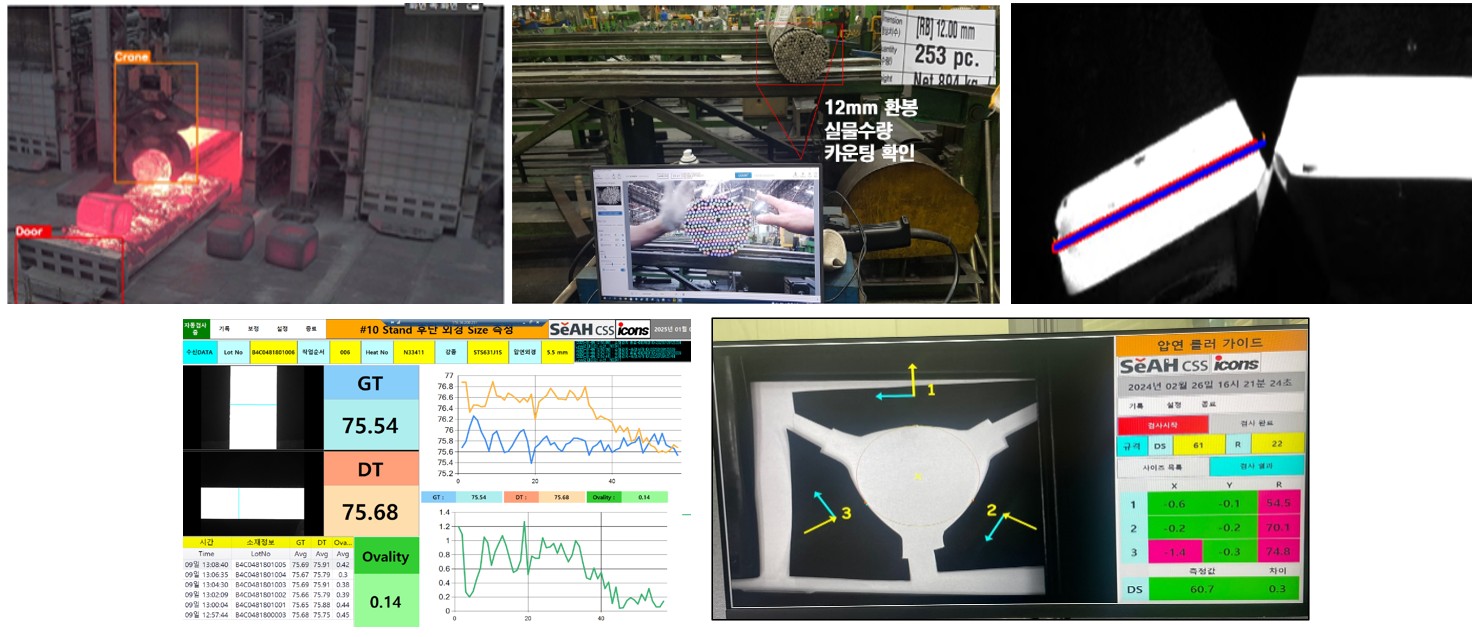
(Clockwise from top left)
2-step forging material tracking, bar counting, material length measurement, material sizing, cox roll guide setting
Automating Repetitive Processes and Improving Work Environments
The impact of DX becomes most evident on the shop floor. Previously, counting round bar bundles before shipment required workers to manually count 216 individual 1.6mm-diameter bars all day long. The integration of smart cameras and a tablet-based application enabled the system to automatically recognize and record the count on-screen, even if the bars were imperfectly aligned. This marked the first successful AI application at SeAH CSS, significantly reducing worker fatigue and minimizing the potential for human error.
Advancing Processes via Machine Vision
From there, the scope of application expanded. The company implemented machine vision to measure shapes and dimensions during the forging process, and built a system to measure the real-time cutting length of rolled materials moving at 50 km/h. For aerospace materials, which undergo complex heating and transfer processes, a machine vision-based algorithm was applied to track materials whose positions constantly shift. This system played a crucial role during the rigorous aerospace certification process.
These examples demonstrate that AI serves as a tool to augment human judgment in the field, rather than a technology designed to replace the workforce. DX is evolving beyond mere automation toward enhancing the overall accuracy of decision-making.
Manufacturing Competitiveness Forged by Data-Driven Operations
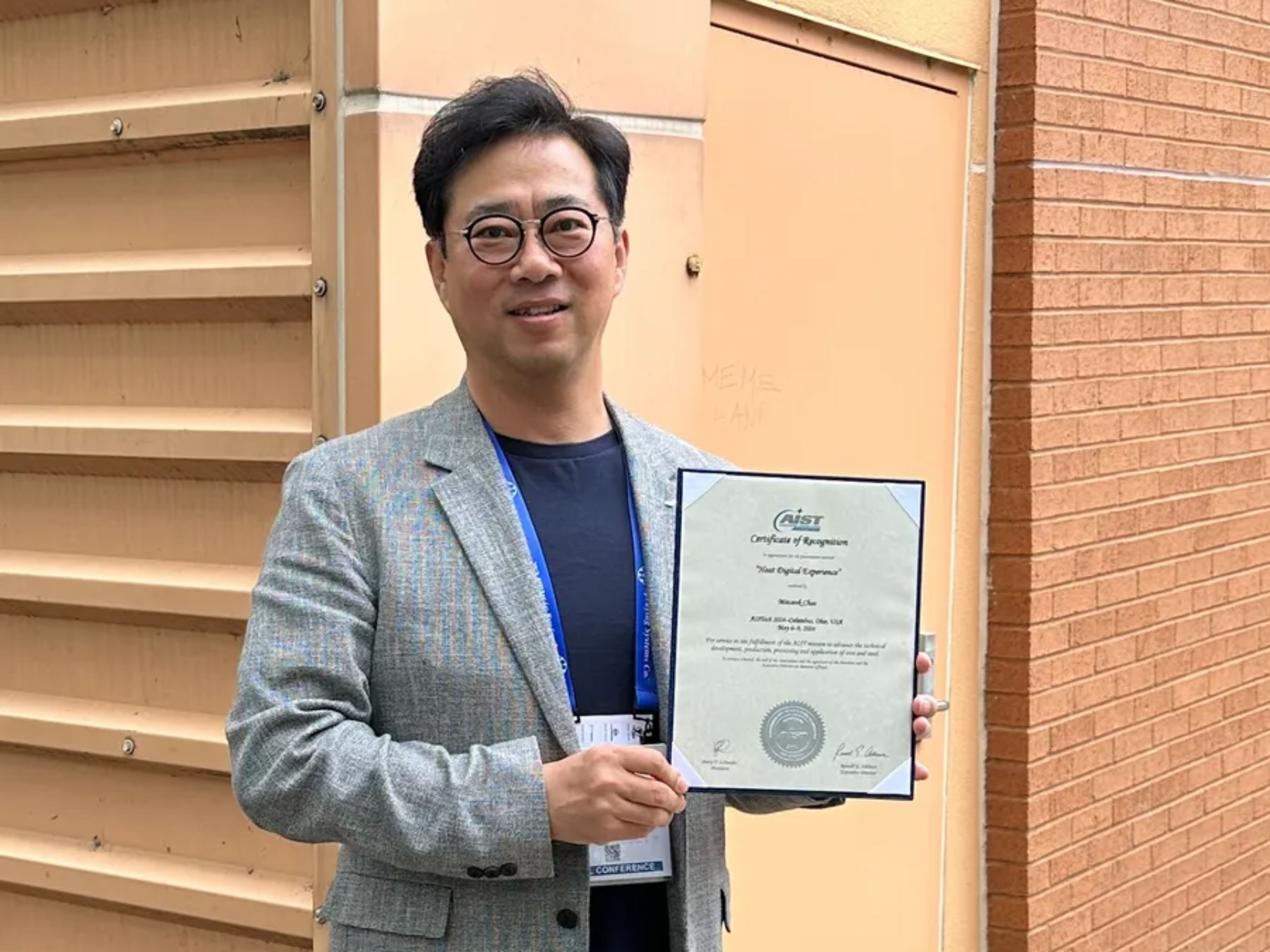
Chae presenting the AI-based refractory erosion prediction model at The Association for Iron & Steel Technology (AIST).
Data Forge and Building the Data Infrastructure
The necessity of DX becomes even more apparent during the infrastructure-building phase. To integrate data across its plants, SeAH CSS completely redesigned its network and built an open-source data platform called Data Forge. Data collected every second from each plant passes through edge servers and is stored in the cloud, where AI models use it for continuous learning. The validated models are then deployed back to the field servers to provide operational guides and predict product quality.
For AI to actually work on the shop floor, structural foundations must precede the technology. Industrial AI only translates into genuine competitiveness when there is a complete feedback loop—where data flows in, is analyzed, and returns actionable insights back to the field.
A Human-Centric Digital Transformation Culture
People are just as critical as the technology. Approximately 430 employees have completed data literacy training, and over 100 of them have received advanced education in big data and AI, equipping them with practical problem-solving skills. Internal programs, such as the company's annual data analysis competition, play a key role in embedding AI as a company-wide operational culture, transcending the boundaries of a specific IT department.
Today, how a manufacturing company operates its processes and delivers value to its customers determines its true competitiveness, far outweighing the physical goods it produces. Industrial AI in the era of DX goes far beyond technological implementation, finding its ultimate value in a virtuous cycle that converts field intuition into data and returns it to the shop floor.
AI projects may not always yield immediate, eye-catching results. However, as these initiatives accumulate, the very way we work begins to change. A data-driven work culture built over several years becomes the driving force that fundamentally transforms the organization’s DNA, extending far beyond short-term gains. It fosters a culture that prioritizes defining the problem over rushing to a result, relies on data for judgment, and leverages failures as stepping stones for the next attempt.
Even amidst challenging conditions in the steel market, SeAH CSS has been able to maintain its competitive edge as the company have spent the last seven-plus years steadily cultivating this DX and AI-driven work culture.
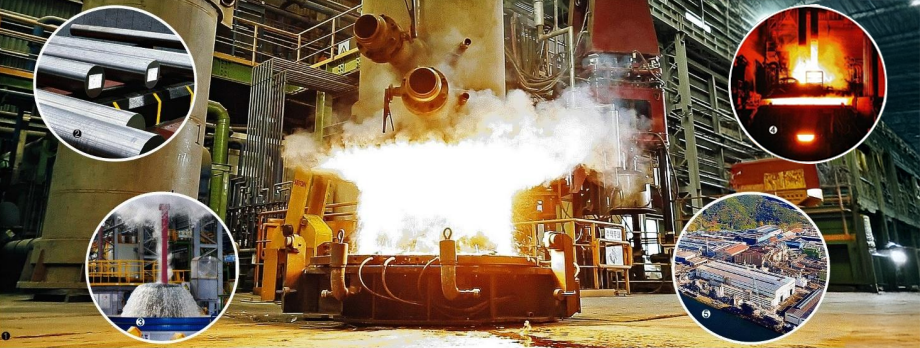
*Copyright belongs to SeAH Group. Unauthorized reproduction and redistribution are prohibited.
*This content was reconstructed based on an interview with Minseok Chae, Head of the R&D Center at SeAH CSS, originally featured in the 2025 Industrial AI Innovation Casebook published by the Korea Industry Intelligentization Association (KOIIA).
List